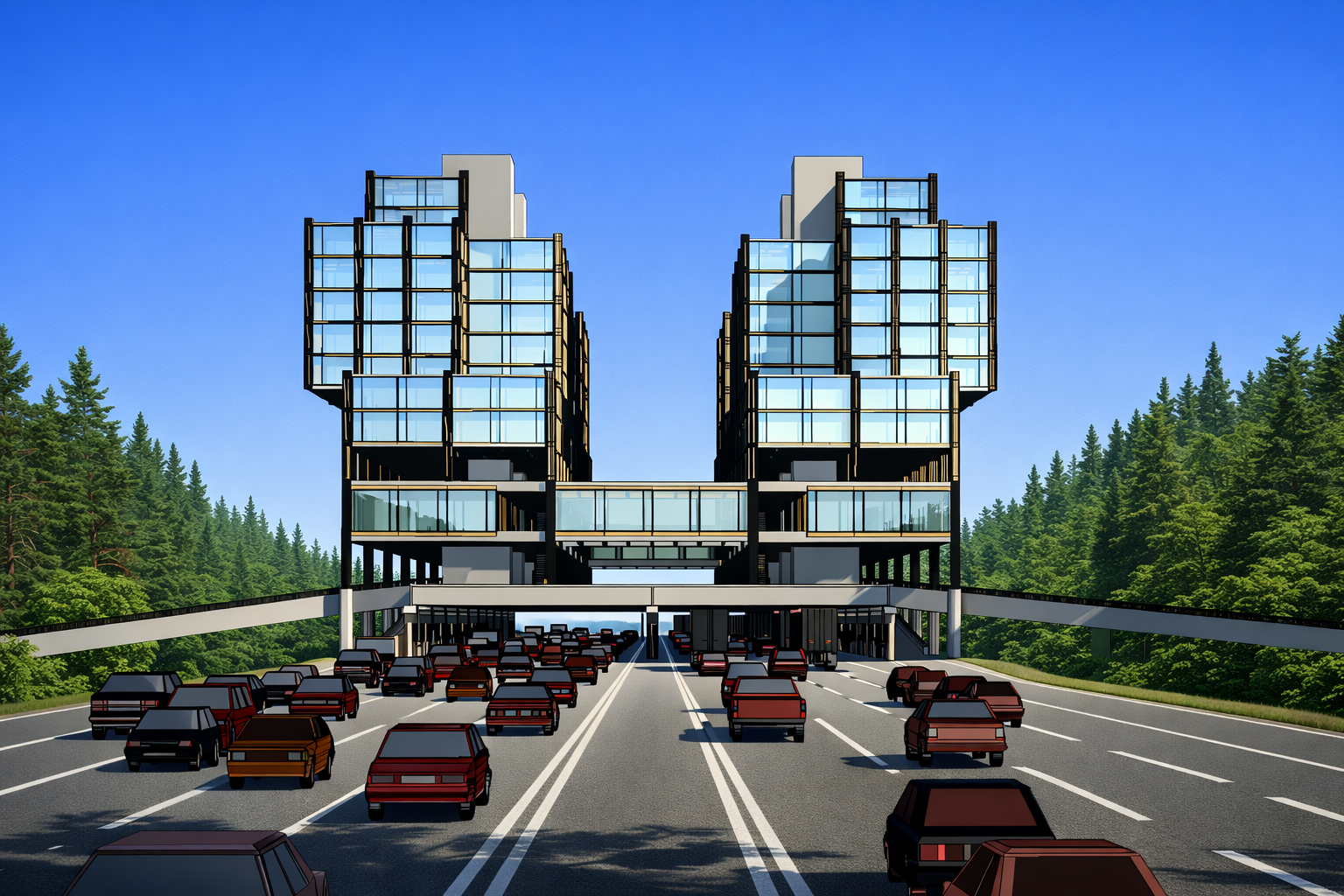
SPEED BUILDINGS are horizontal civic megastructures built over highways, converting transport speed into public accessibility while freeing ground-level territory for restored nature and metropolitan landscapes.
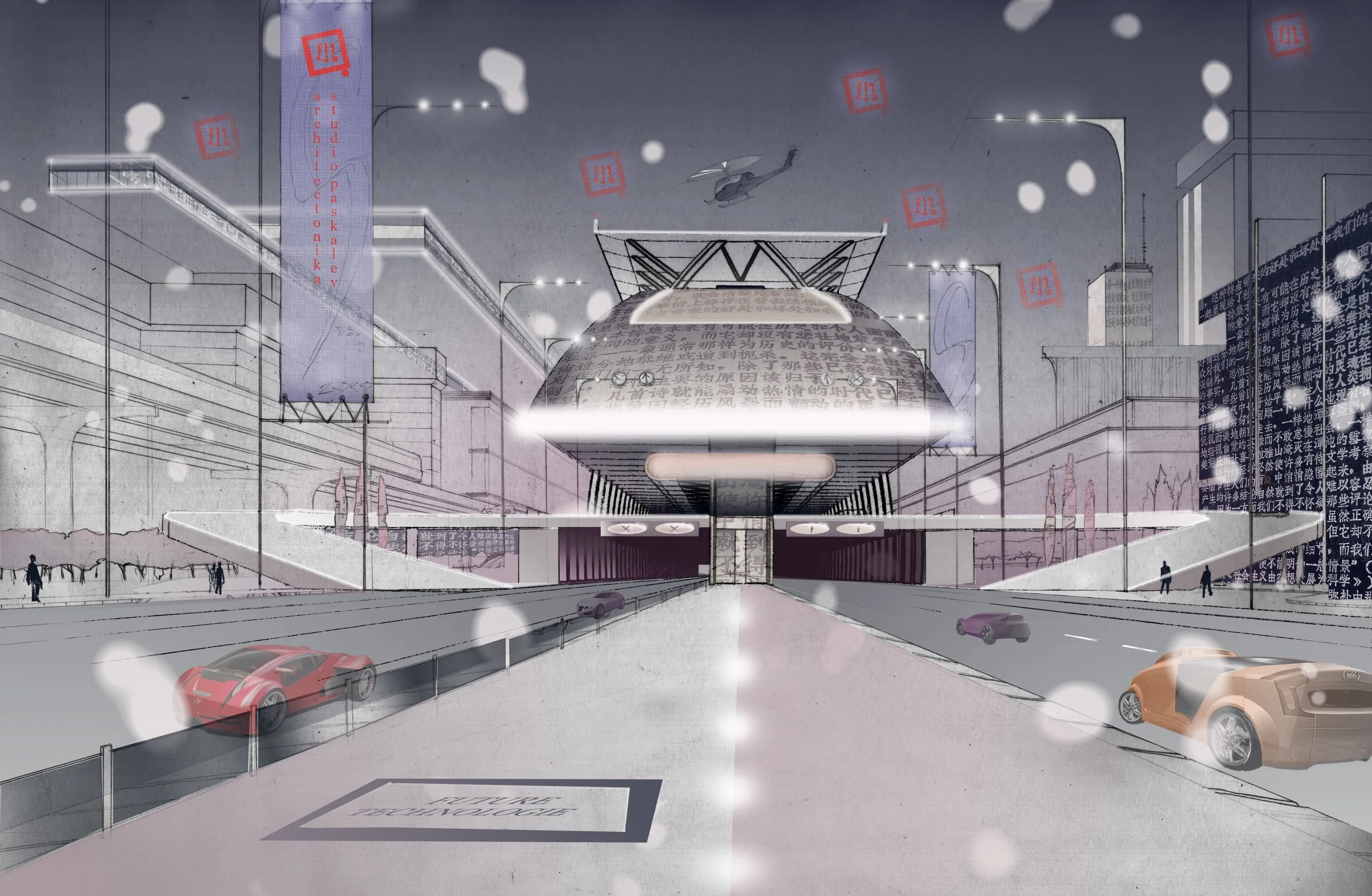
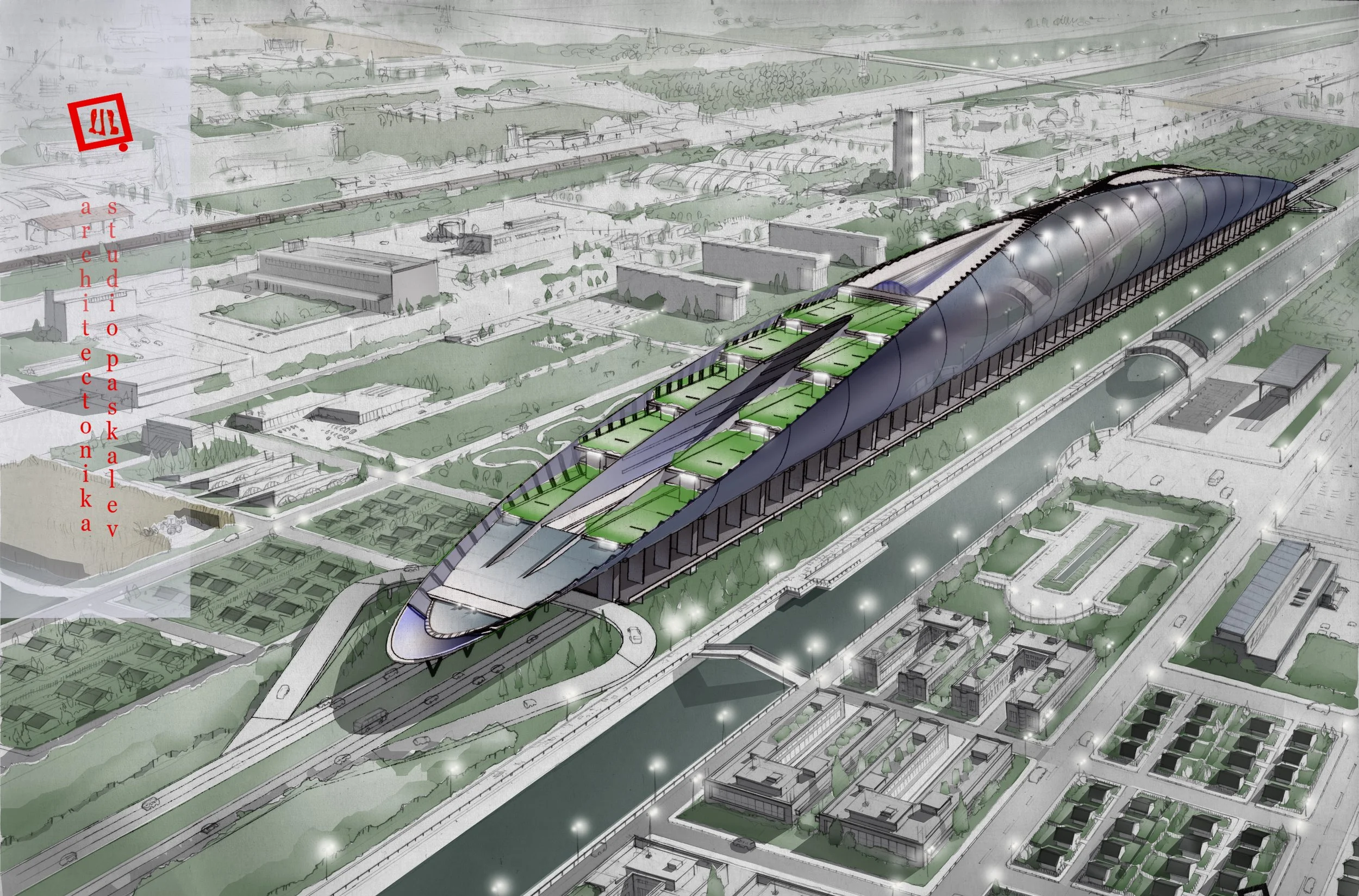
Early artworks dating 2016
Project Overview
SPEED BUILDINGS is a typological proposal for constructing linear public and mixed-use buildings directly over urban highways and high-capacity road corridors. The project reclaims the “empty” spatial layer of transport infrastructure—airspace above roads—transforming it into an inhabitable, programmable territory with high-speed accessibility.
Conceived as horizontal skyscrapers (often extending hundreds of meters up to a kilometer or more), SPEED BUILDINGS reorganize public programs along linear flows rather than vertical stacking. Internal mobility is handled through horizontal circulation systems, allowing large-scale institutions to operate as continuous, infrastructural environments.
The proposal addresses two critical urban deficits simultaneously:
Typology and Program
SPEED BUILDINGS are conceived as infrastructure-integrated civic megastructures hosting programs that benefit from direct, rapid access and metropolitan-scale service radii, such as:
hospitals and emergency departments
ambulance and fire response hubs
crisis management and civil protection
metropolitan administration and civic services
logistics + public services
mixed public programs (education, sports, retail, mobility hubs)
Rather than being “neighborhood destinations,” these buildings operate as strategic metropolitan nodes, aligned with the city’s fastest arteries.
Pillar 1 — Zero Distance (integrating production/logistics into everyday life)
While SPEED BUILDINGS is not primarily a food-production typology, it aligns with the Zero Distance logic through time-distance minimization and operational proximity:
The project reframes “distance” as a systemic metric (time-to-service), not only as meters or location.
Emergency healthcare and public services become nearby in time, regardless of spatial dispersion.
The typology can host distributed logistics and support functions (medical supply, maintenance, municipal operations) embedded within the corridor, reducing long-range urban supply loops and duplicated land-take.
PVW reading: Zero Distance expands from “garden-to-plate” to “service-to-city,” turning speed and infrastructure into proximity.
Pillar 2 — Integration of Transport and Architecture
This is the core pillar of SPEED BUILDINGS.
SPEED BUILDINGS propose a direct coupling between:
dominant mobility systems (highways, metropolitan road networks)
and architectural form (linear megastructure, horizontal circulation, infrastructural sections)
The project treats the highway not as an external constraint but as a primary architectural generator:
access logic is embedded in the corridor
architectural massing aligns with traffic vectors
the building becomes an inhabitable extension of mobility infrastructure
Pillar 3 — Integration of Nature and Habitation
SPEED BUILDINGS makes a strategic shift: instead of competing with nature for ground-level land, it relocates large building mass into the airspace above infrastructure, enabling ecological recovery at grade.
Key nature outcomes:
freed land along corridors can become continuous parks and ecological buffers
highways can be reframed as green linear landscapes, not urban scars
potential for multi-level urban ecology: mobility below, inhabitation above, nature restored adjacent and beneath
the typology supports a “layered city” where systems coexist without direct conflict
Importantly, the project proposes nature not as decorative greenery on a façade, but as territorial restoration—a spatial and ecological rebalancing.