Forest Quarter represents a typological innovation that redefines the relationship between ground, density, and ecology. It transforms the urban jungle into a layered ecosystem, where architecture coexists with — rather than replaces — natural systems.
It is not a green building.
It is a new urban model.
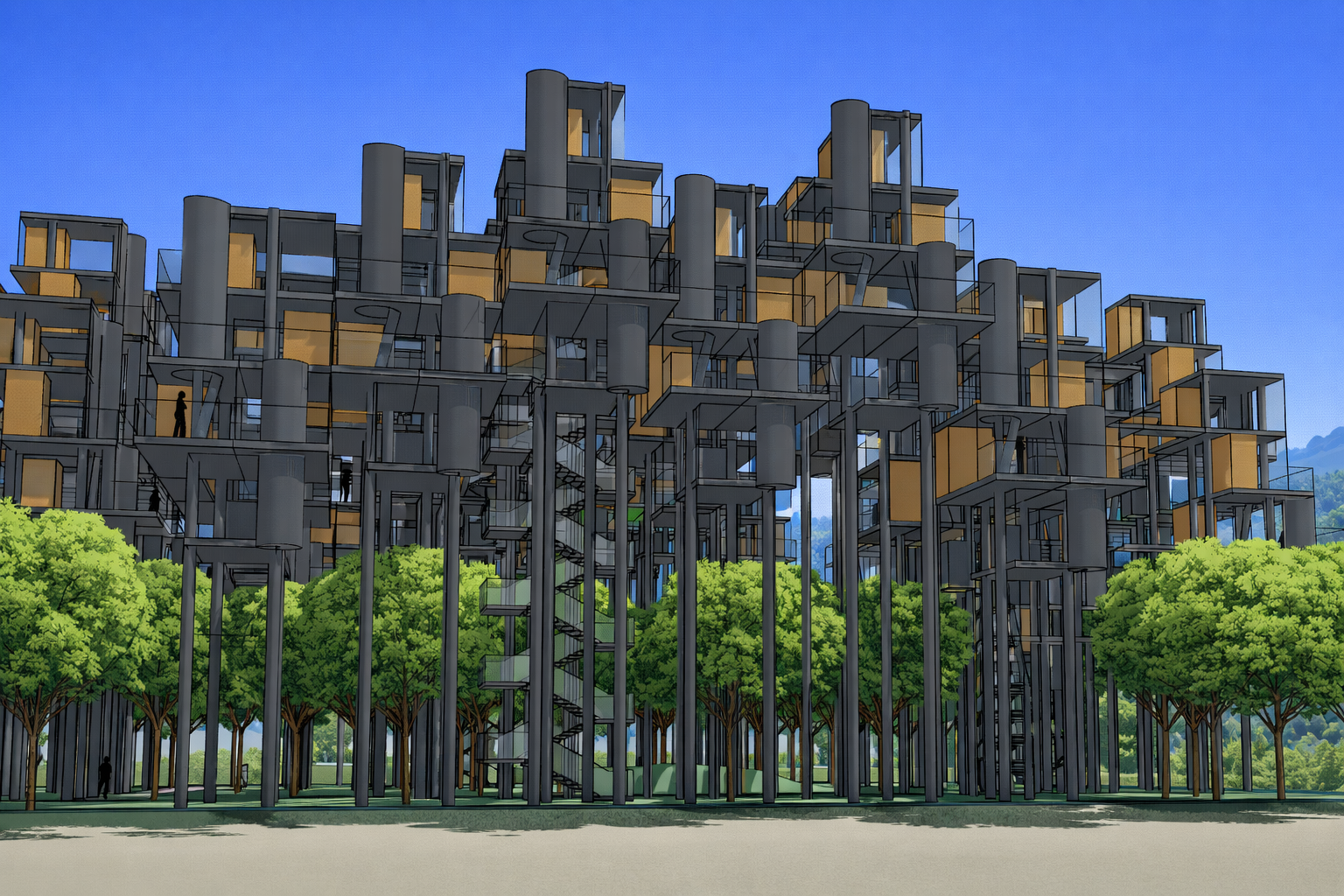
FOREST QUARTER
A Typological Shift Toward a Layered Urban Ecosystem
Forest Quarter proposes a radical rethinking of urban ground, density, and ecological integration. Instead of occupying land with compact building masses, the project lifts habitation above the ground, creating a porous, multi-layered urban ecosystem inspired by forest logic.
Rather than adding greenery onto architecture, the project restructures the relationship between city and nature at a typological level.
Sustainability as a Typological Question
Forest Quarter does not treat sustainability as applied technology — solar panels, green roofs, or façade systems.
Instead, sustainability is embedded in the spatial model itself.
By lifting residential units onto structural columns:
the ground is liberated for continuous urban forest,
solar access is preserved through controlled porosity,
heat island effects are reduced through large-scale vegetation,
biodiversity corridors are reintroduced at the urban scale.
The ecological performance is not decorative — it emerges from the structural logic of the typology.
Sustainability becomes a spatial strategy.
We Do Not Optimize Existing Models — We Propose New Ones
Forest Quarter does not refine the perimeter block or the tower typology.
It questions the fundamental assumption that buildings must occupy the ground.
The project introduces:
Elevated living clusters instead of ground-based blocks
Porous aggregation instead of continuous façades
Multi-level ecosystems instead of mono-functional zoning
This is not densification — it is vertical reconfiguration of urban layers.
The proposal shifts the paradigm from:
density as mass → density as layered ecology
Integration of Nature and Habitation
This pillar is central to Forest Quarter.
The project establishes a spatial separation of systems:
Ground level → urban forest, biodiversity, public life
Elevated level → habitation
Vertical cores → structural trunks connecting layers
By learning from forest stratification, the project creates:
a canopy layer of housing,
a sub-layer of light-filtered landscape,
continuous air and light permeability.
Nature is not framed as scenery.
It becomes the primary urban layer.
Architecture becomes a secondary, suspended system.