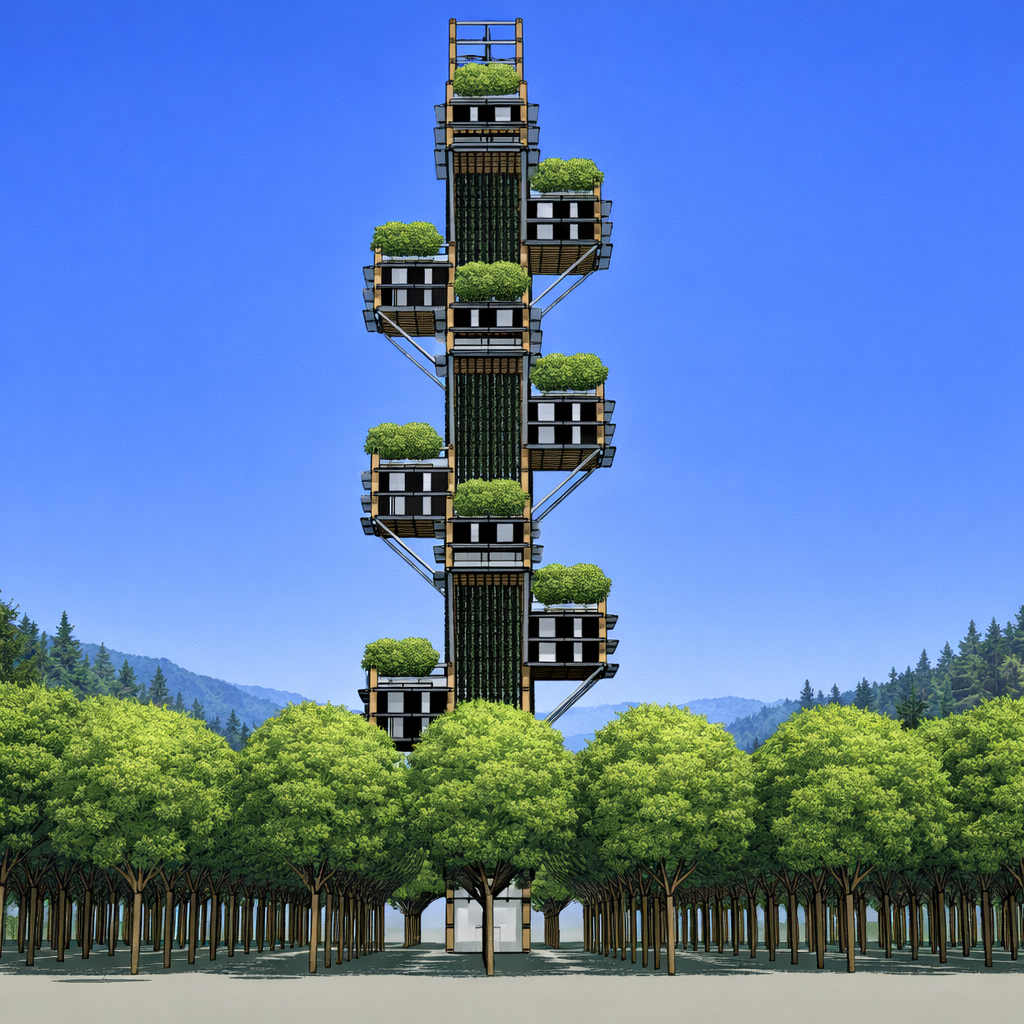
GARDEN TOWER
A Typological Prototype for Autonomous Vertical Communities
GARDEN TOWER is a 100-meter-high residential structure accommodating only ten families within a vertically organized, fully automated food-production core. With a ground footprint of just 8 × 8 meters, the tower minimizes land occupation while integrating habitation, agriculture, and renewable energy into a single architectural system.
Unlike contemporary “green towers” that apply vegetation as a façade layer, GARDEN TOWER proposes a fundamentally different typology: a productive vertical ecosystem. At its center lies a stack of automated, AI-operated vertical gardens operating 24/7 under controlled lighting and climate conditions. These high-efficiency systems generate up to ten times the yield of conventional horizontal agriculture.
From this productive core, two-level residential capsules cantilever outward. Each dwelling is structurally and programmatically connected to a portion of the vertical garden that sustains it. The building is designed to be fully energy-independent and structurally realized through the PVW modular construction system.
Rather than dispersing settlement horizontally through land consumption, GARDEN TOWER concentrates life vertically — preserving the surrounding landscape intact.
Food Production and Living
The first pillar of PVW redefines sustainability as a typological task, not a technological add-on.
GARDEN TOWER eliminates the spatial separation between habitation and agriculture. Food production is no longer externalized to distant rural territories but embedded directly within the domestic structure. The “distance from garden to plate” becomes effectively zero.
This reconfiguration dissolves the traditional dichotomy between city and countryside. The tower functions simultaneously as home and farm, transforming verticality into a productive landscape. The result is not decorative greenery, but an infrastructural integration of food systems into architecture.
Mobility and Architecture
Historically, dominant modes of transportation have shaped urban form. PVW’s second pillar investigates how new mobility paradigms reshape architectural typologies.
Although GARDEN TOWER is not a transport-integrated structure per se, it responds to the same systemic logic: by drastically reducing land consumption and agricultural sprawl, it restructures territorial organization. Autonomous vertical communities could emerge in forest belts, peri-urban zones, or protected landscapes without triggering conventional suburban expansion.
In this sense, GARDEN TOWER anticipates a post-automobile territorial model where density no longer requires infrastructural sprawl. It proposes concentrated vertical settlements that coexist with ecological systems rather than replacing them.
Nature and Habitation
The third pillar of PVW seeks a higher level of integration between natural ecosystems and built environments.
GARDEN TOWER does not impose urbanity onto nature; it minimizes its physical imprint and enables the surrounding ecosystem to remain continuous at ground level. With its 8 × 8 meter footprint, the building acts more as a vertical extension within a forest rather than a clearing within it.
Moreover, the tower itself participates in ecological cycles:
carbon capture through plant systems
oxygen production
potential habitat formation
integration into local biodiversity networks
Instead of urbanizing the forest, it introduces a vertical ecological artifact capable of coexisting with it.
Toward a New Typology of Autonomous Communities
If replicated at scale — for example, ten towers hosting one hundred families within a forested landscape — GARDEN TOWER demonstrates a model of settlement that:
avoids deforestation for agriculture
replaces manual rural labor with automated systems
liberates human time for cultural, scientific, or creative activity
concentrates density without generating urban sprawl
GARDEN TOWER is therefore not a speculative image, but a typological hypothesis:
an architecture of self-sustaining vertical communities capable of inhabiting natural environments without destroying them.
It represents a shift from sustainable buildings to sustainable territorial systems, where architecture becomes productive infrastructure — and density becomes ecological.